What Typically Developing Kids Gain in an Inclusive Preschool
On almost every tour of Zach’s Place, a parent asks some version of the same question. Sometimes they say it outright. Sometimes they just hint at it.
“My child doesn’t have a disability. Is an inclusive preschool still the right place for them?”
It’s a fair question, and we’re glad when parents ask it. The short answer is yes. The longer answer is worth a few minutes, because what your child gains in an inclusive room goes well beyond letters and numbers.
What “Inclusive Preschool” Actually Means
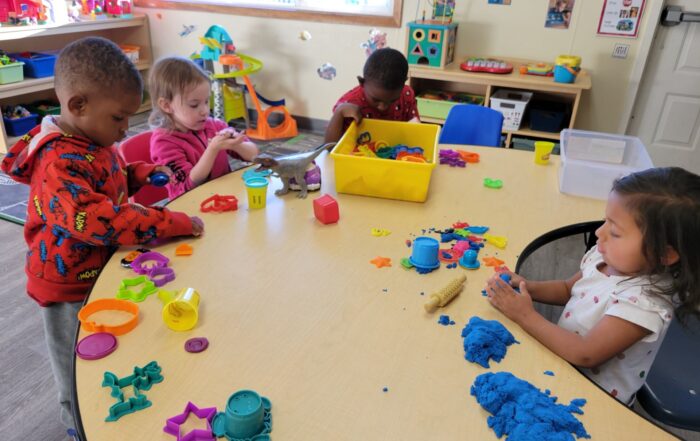
An inclusive preschool is one where children with and without disabilities share the same classroom, the same routines, and the same activities. There’s no separate room down the hall.
At Zach’s Place, a typical morning might include a child who talks nonstop, a child who uses a few signs or a picture board, a child who needs help with stairs, and a child who’s working hard on waiting their turn. Teachers plan the day so everyone takes part: the same story, the same snack table, the same playground.
What Typically Developing Children Gain
Research on early childhood inclusion, including the joint policy statement from the U.S. Departments of Education and Health and Human Services, has found that children without disabilities do well in inclusive programs. They keep pace on early learning and often show stronger social skills and more positive attitudes toward differences. Here’s what that looks like in a real classroom.
Empathy they practice, every day
Preschoolers learn kindness best by doing it. When a friend needs a minute to finish a puzzle or a hand getting to the circle, children start noticing what others need and offering help without being asked.
Communication beyond words
Children in inclusive rooms learn that people communicate in lots of ways. They pick up simple signs, learn to read a friend’s face, and figure out how to rephrase when they aren’t understood. Those are strong communication skills at any age.
Patience and flexibility
Waiting, adjusting a game so everyone can play, and handling a change in plans are hard for 3- and 4-year-olds. An inclusive classroom gives them plenty of low-stakes practice.
Comfort with difference
Kids who grow up with classmates of every ability tend to see a wheelchair or a communication device as ordinary. That comfort follows them into kindergarten, the neighborhood, and eventually the workplace.
The same school-readiness foundation
Inclusion doesn’t replace early learning. Children still work on letters, counting, following group directions, and the routines that make kindergarten go smoothly.
Questions Parents Ask Us Most
Will my child get less attention?
Teachers in an inclusive classroom plan for a wide range of needs from the start, so the day is built around individual attention rather than one pace for everyone. Ask about staffing and group sizes when you tour, and look at how teachers move around the room.
Will it slow down my child’s learning?
The research above says no. Children learn at their own pace in any classroom, and a child who’s ready for more gets more.
What to Look For When You Tour
Any program can call itself inclusive. A tour shows you whether it really is. A few things worth watching for:
- Children of different abilities playing together, not just sitting in the same room.
- Teachers adjusting an activity on the spot so every child can join in.
- Visual schedules, quiet spaces, and other supports that help the whole class.
- Staff who answer your questions about your child specifically, not with a brochure script.
Inclusion Works Both Ways
Children with disabilities benefit from playing alongside peers who model language, play, and social skills. They also get something harder to measure: a real sense of belonging in a class of friends.
That’s the point of inclusion. Every child is a full member of the group, and every child learns from the others.
An Inclusive Preschool in Colorado Springs
Zach’s Place at the Laurie Hillyard Family Center serves children from age 2.5 through 18 at 4795 Granby Circle in Colorado Springs. We’re a licensed Colorado Universal Preschool (UPK) provider, so eligible children in the year before kindergarten can receive up to 15 hours of free preschool each week.
Families who need longer days can add extended hours on our sliding fee scale. Special Kids Special Families has served Colorado Springs families since 1998.
See an inclusive classroom for yourself. Schedule a tour by calling 719-447-8983 or visiting sksfcolorado.org.
Frequently Asked Questions
Is an inclusive preschool a good fit for a child without a disability?
Yes. Research on early childhood inclusion has found that typically developing children do well in inclusive programs and often show stronger social skills and more positive attitudes toward differences, while building the same school-readiness skills.
Will my child get less teacher attention in an inclusive classroom?
Inclusive classrooms are planned around individual needs from the start. When you tour, ask about staffing and group sizes and watch how teachers work with children one-on-one.
What is the difference between inclusive preschool and special education preschool?
A special education preschool serves only children with identified disabilities. An inclusive preschool brings children with and without disabilities together in the same classroom and routines.
Does Zach’s Place offer Universal Pre-K?
Yes. Zach’s Place is a licensed Colorado UPK provider. Eligible children in the year before kindergarten can receive up to 15 hours of free preschool each week, with extended hours available on a sliding fee scale.
How do I schedule a tour of Zach’s Place?
Call 719-447-8983 or visit sksfcolorado.org. We’ll set up a time for you to see the classrooms and ask questions.
Recent Posts






SKSF E-Newsletters
FAQs about SKSF Child Care in Colorado Springs
Inclusive child care programs in Colorado Springs are supported by key laws such as the Individuals with Disabilities Education Act (IDEA), the Americans with Disabilities Act (ADA), Section 504 of the Rehabilitation Act, and the Head Start Act. These legislations ensure equal access to education and childcare services for children with disabilities and mandate the establishment and maintenance of inclusive practices within local childcare settings.
Yes. Our staff are trained to support children with diverse developmental needs in a structured, nurturing environment. We encourage families to share specific care details during enrollment discussions so we can ensure the best experience.
Inclusive child care refers to early childhood programs that integrate children with disabilities alongside their typically developing peers, providing adapted activities and individualized support. In Colorado Springs, such inclusive settings are vital as they foster life skills development, cognitive growth, and social competence for children with disabilities, ensuring they have equal opportunities to learn and thrive within a supportive community.
Licensed child care ensures that caregivers are properly trained and qualified to meet the unique needs of children with disabilities. In Colorado Springs, licensed facilities follow strict regulations that promote safety, quality care, and inclusive environments, which are essential for the well-being and development of special needs children.
Our staff are trained to support children across a broad range of developmental profiles in an inclusive classroom environment. Activities are thoughtfully adapted so that children with and without disabilities can participate together, each benefiting from the interaction. We maintain small group sizes, have an RN on staff, and coordinate closely with families to ensure each child’s individual needs are met throughout the day.
SKSF in Colorado Springs offers a wide range of programs including foster care, behavioral health support, community day programs, mentorship opportunities, counseling, workforce development, and specialized respite care like Zach’s Place at The Laurie Hillyard Family Center. These comprehensive services support families beyond childcare to enhance overall quality of life.
Yes. Zach’s Place operates on a sliding-fee scale based on household income, which means families pay what they can afford — with rates as low as $9 per hour for qualifying families. Colorado families may also be eligible for support through the Colorado Child Care Assistance Program (CCCAP) or state disability services funding. Our team can help connect you with information on any of these options during your intake visit.
Zach’s Place serves children ages 2.5 through 18, making us one of the few child care and respite programs in the Colorado Springs area that supports children across such a broad age range. This includes school-age children who need care before and after the school day as well as children who require specialized support during those hours.
Yes. Zach’s Place offers flexible short-term child care options for families visiting Colorado Springs or needing temporary support. Availability depends on scheduling and enrollment requirements, so we encourage families to contact us in advance.
An inclusive preschool brings together children of all abilities in one shared learning environment. Children learn alongside peers with diverse strengths and learning styles, helping them develop communication skills, empathy, confidence, and cooperation in a natural classroom setting.